How to block social media as a Christian without white-knuckling it
Social media fasts break by reflex, not by decision. A different approach: make prayer the door you have to walk through.
By the Behold team · Updated
Short answer: deleting the apps works for about four days, because deleting removes the app but not the reach. The approach that lasts is to leave social media installed and put something in front of it that you have to actually do. For Christians, prayer is the natural gate. Block the apps during set Prayer Times, and unlock them by praying rather than by tapping.
You have probably already tried the two standard moves. Delete Instagram, then reinstall it on day five, “just to check one thing”. Set a limit, then learn the Ignore button. Both fail for the same reason, and it’s worth understanding the reason before you try a third thing.
Why the social media fast breaks
A fast is a decision. The scroll is not a decision.
Think about the last time you opened Instagram. You almost certainly cannot remember choosing to. You were bored in a queue, or anxious about an email, or lying awake, and your hand did the rest. The choosing part of you was not consulted.
So when you delete the app, you’ve won an argument that was never being had. The reach is still there, running on the same trigger: a gap in the day, a spike of discomfort. It finds YouTube. It finds the news. It finds Safari, where Instagram works perfectly well without an app. And within a week or two, it finds the App Store.
This is also why the fast tends to end in a worse place than it started. You didn’t just go back to Instagram; you went back having proven to yourself that you can’t stay away. That’s the part that stings, and it’s the part that makes people stop trying.
What Scripture actually asks for here
It’s worth being clear that the goal is not a phone-free life. Nobody’s called to that, and pretending otherwise sets up a standard you’ll fail on purpose.
The concern is older and simpler: what gets your first attention. “Seek first the kingdom.” “Set your minds on things above.” The question is not whether you use Instagram. It’s whether Instagram gets the part of you that used to be reserved: the first ten minutes, the quiet gap, the last thought before sleep.
That reframe matters practically, because it changes the target. You’re not trying to eliminate social media. You’re trying to make sure it isn’t first. That’s a much smaller, much more winnable fight.
The approach that holds: make prayer the door
Leave the apps installed. Put a gate in front of them. Make the gate something you have to do rather than something you can dismiss.
This works for three reasons:
It doesn’t rely on willpower at the moment of weakness. The decision is made once, when you’re calm, at setup. At 6:40am you’re not deciding anything. You just meet the gate.
It fills the vacuum. The reason fasts collapse is that removing something leaves a hole and holes fill. If the gate produces a minute of prayer, the hole is already filled by the time you get through it.
It turns the reflex into an ally. This is the part that surprises people. After about a week, the reach for the phone starts producing prayer automatically, using the same reach that was costing you the morning. You didn’t have to defeat the reflex. You put something good at the end of it.
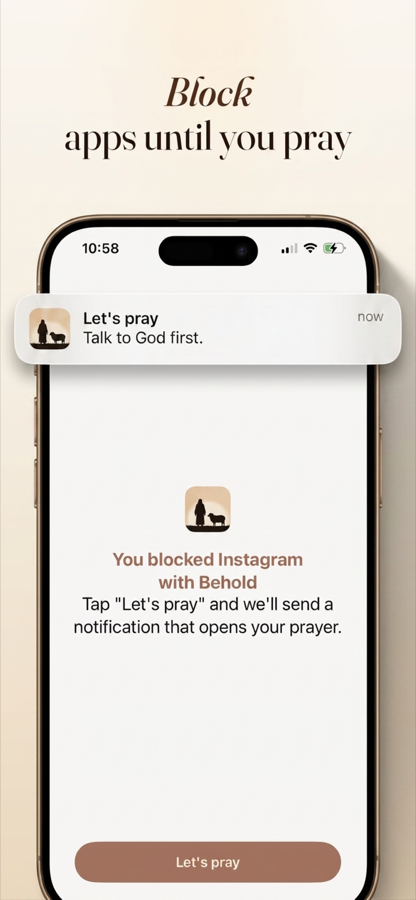
In Behold: set your Prayer Times, choose which social apps go quiet during them, and those apps stay locked until you’ve prayed. About sixty seconds, guided, with no ignore button on the block screen. Free to download.
Setting it up
Choose your apps. Instagram, TikTok, X, Facebook, Reddit, YouTube: whichever ones your thumb goes to unbidden. Leave Messages, Phone and Maps alone; blocking those manufactures an emergency and an emergency is a permanent excuse.
Choose your Prayer Times. Start with the morning one, because the morning is where the day gets set. Give yourself a realistic window: the fifteen minutes after you’d actually be sitting up, not the second the alarm goes.
Pray to unlock. When the block screen appears, Behold walks you through P.R.A.Y.: Praise, Repent, Ask, Yield. Four prompts, words provided if you don’t have your own. Then the apps open.
Add Boundaries once you’ve got the rhythm. Boundaries are daily per-app limits: how much Instagram you actually want in a day rather than how much you drift into. Set them in week two, based on what week one showed you.
Add Practices for the fixed points. Sunday morning. Dinner. Small group. Work hours. Windows where the phone stays quiet regardless.
When you reinstall, and you will
At some point you’ll turn something off, or delete Behold, or blow through a Prayer Time three days running. Here is the most useful thing in this guide:
That is not the experiment failing. That is Tuesday.
The mistake is treating the lapse as a verdict on your character, because that reading always ends the same way: shame, then abandonment of the whole system, then back to the old baseline plus one more failure on the tally.
The Prayer Ring exists partly for this. It shows you the shape of the week (kept, missed, still ahead) as a picture rather than a streak you have to defend at all costs. Streaks make missing a day catastrophic. It isn’t. Reopen the app, set the Prayer Time again, and take tomorrow morning.
What this is honestly not
Behold uses Apple’s Screen Time framework, like every real blocker on iPhone. That framework means someone holding your unlocked phone can go into Settings and disable it. No iOS app can prevent that, and any app that says otherwise is overselling.
What’s removed is the ignore button: the one-tap dismissal that made your old limits meaningless. The reflex lives in the one-tap zone. It does not survive a deliberate trip through Settings. That’s the gap the whole thing works in.
If you want it stronger: have your spouse or a friend set your iPhone’s Screen Time passcode without telling you. Then getting past Behold means having a conversation, which is exactly the friction that a private failure never has.
Start smaller than you want to
The instinct is to lock everything on day one. Resist it. That’s the same all-or-nothing energy that made the last fast collapse.
One app. One Prayer Time. Tomorrow morning. If that holds for a week, add the second thing.
Try it tomorrow morning
Set one Prayer Time. Pick one app. That is the whole setup, and it takes about two minutes.