The P.R.A.Y. method: what to say when you don't know how to pray
For when you sit down to pray and your mind goes blank. Four steps, sixty seconds, no experience required.
By the Behold team · Updated
Short answer: P.R.A.Y. is a four-step shape for prayer: Praise, Repent, Ask, Yield. You say something true about God, name one thing you’re sorry for, ask for what you need today, and hand the day over. It takes about sixty seconds and requires no experience. Its whole purpose is to give you somewhere to start when you sit down to pray and your mind goes blank.
Almost everyone who wants to pray more runs into the same wall. Not doubt, not lack of desire. Blankness. You close your eyes and produce a shopping list, an argument from three years ago, and a vague sense that you’re doing this wrong.
An acrostic isn’t a spiritual technology. It’s scaffolding. You use it until you don’t need it, the same way you’d use training wheels or a recipe. The prayers themselves are as old as the Psalms; P.R.A.Y. just puts them in an order you can remember while half awake.
P: Praise
Start with who God is, not with what you need.
This isn’t flattery and God isn’t fishing for compliments. It’s orientation. Beginning with what’s true about God resets the size of everything else, including the thing you’re anxious about, which will be along shortly in the Ask step and which will look different by then.
You do not need to be eloquent. One true sentence:
- “You’re good. You were good yesterday even when I couldn’t tell.”
- “You made this morning. You didn’t have to.”
- “You’re still God and I’m still not. Thank you.”
If nothing comes, borrow. Psalm 103: “Bless the Lord, O my soul, and all that is within me, bless his holy name.” Praying someone else’s words is not a shortcut around real prayer. It is most of what the Church has done for two thousand years.
R: Repent
Name one thing. Turn. Move on.
Two errors live in this step, in opposite directions.
The first is skipping it, which makes prayer a service desk. The second, much more common among people who care, is turning it into an inventory and then into self-punishment. That’s where you list every failure, circle the same one for four minutes, and get up feeling worse than when you sat down.
Repentance is turning. The word means changing direction. It is meant to be short:
“I gave the morning to my phone again yesterday. I’m sorry. Today I’m giving it to you.”
That’s a complete repentance. Named, honest, and finished. The forgiveness on offer is not scarce and it is not conditional on how bad you managed to feel about it.
If you notice you’ve been on this step for a while and you feel worse rather than lighter, that’s not conviction anymore. Cut it short and go to Ask.
A: Ask
Ask for today specifically.
Generic prayer is hard to sustain because you can’t tell if anything happened. “Bless my family” is fine, but “help me not snap at Sam before school” is a prayer you’ll remember at 8:15 and know the answer to by 8:30.
So: the meeting at ten. The scan results. The conversation you’ve been avoiding since Sunday. The friend whose name you keep meaning to bring up and don’t.
Ask plainly. There’s no register you need to switch into. “Please” works. And ask for yourself as well as others; petition on your own behalf is all over the Psalms and the Lord’s Prayer both.
Y: Yield
Hand the day over.
This is the step people skip, and it’s the one that changes how you walk out of the room.
Yield is where you stop directing. You’ve praised, you’ve turned, you’ve asked. Now you let go of the outcome. It’s the “not my will, but yours be done” of Gethsemane, in miniature, applied to a Tuesday.
- “This day is yours. I’ll take it as it comes.”
- “You know what’s in it. I don’t. That’s fine.”
- “Whatever happens at 2pm, you’re in it before I get there.”
Yield is what turns prayer from a transaction into a handover. It’s also, in practice, the step that makes the rest of the morning feel different.
The whole thing, at speed
Here is a complete P.R.A.Y. prayer, at 6:40am, in about forty seconds:
Praise. You’re good, and you were good yesterday when I couldn’t feel it.
Repent. I was short with her last night. I’m sorry. I’ll go and say so.
Ask. Please help with the ten o’clock. And be with Dad today, he’s scared.
Yield. Today’s yours. Not my will. I’ll take it as it comes.
That is a real prayer. It is not a lesser version of prayer that you should feel apologetic about. The long, unhurried version is wonderful and will happen more often than you think, but only if the minimum is something you actually hit on ordinary days.
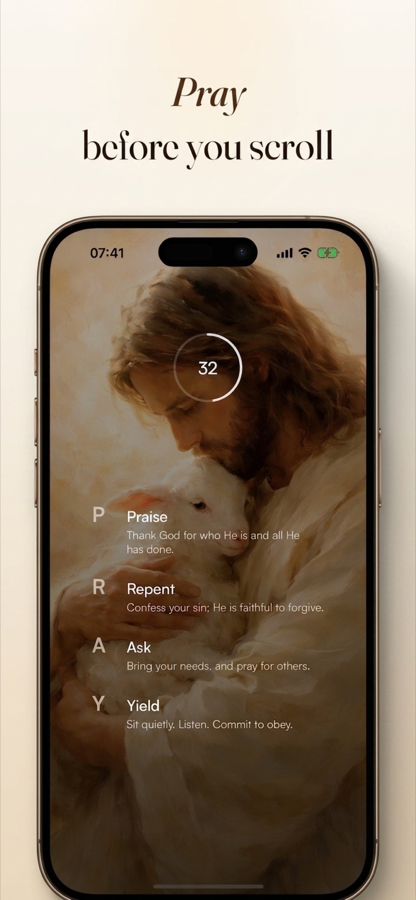
Behold walks you through these four steps every time your Prayer Time locks the apps you’ve chosen, with prompts to borrow when you have no words of your own. About sixty seconds, then the apps unlock. Free on the App Store.
Using P.R.A.Y. as a daily habit
A shape solves the blankness. It does not solve the forgetting. You can know P.R.A.Y. perfectly and still not pray for eleven days, because nothing in the day makes you.
The fix is a trigger: something that already happens reliably, every day, that you can hang the prayer on.
You have one. You reach for your phone within seconds of waking, every single morning, without deciding to.
That’s what Behold uses. You set a Prayer Time for your morning window and choose which apps go quiet during it. When you reach for Instagram at 6:40, you get a block screen with no ignore button, and P.R.A.Y. on the other side of it. Pray, and the apps open.
The reflex that has been costing you the morning starts producing the prayer instead. You never have to remember, because the phone remembers for you.
Over the week the Prayer Ring shows the shape of what you kept and what you drifted past: a picture, not a streak to defend.
Questions people ask
Do I have to do the steps in order? No. The order is useful because praise first changes how the asking feels, but nobody is marking this.
What if I can’t think of anything for Praise? Borrow a Psalm. That’s what they’re for.
Is sixty seconds enough? It’s enough to be real. It’s a floor, not a ceiling, and a floor you clear daily beats a ceiling you never reach.
Is an acrostic too formulaic? It’s a starting shape, like a recipe. You’ll stop needing it, and by then you’ll have the habit, which was the point.
Try it once
Right now, before you close this: one true thing about God, one thing you’re sorry for, one thing you need today, and one sentence handing the day over.
That’s the whole method. Tomorrow morning, the only remaining question is whether anything will remind you.
Try it tomorrow morning
Set one Prayer Time. Pick one app. That is the whole setup, and it takes about two minutes.